For the people who answer
The main line is ringing. Who’s covering it?
That number is the firm. It sits on the website, the Google listing, the cards in the lobby, and every phone a client has saved from the last matter. When someone dials it, they are not asking for a feature. They are asking whether this office can be reached, and whether the person who answers can do something useful with the call.
Most offices did not hire an office manager to become the phone company. They hired them to keep the place running. Then someone leaves, the greeting still says last year’s hours, and the next caller gets a closed message in the middle of a workday.
If that is a Tuesday at your office, it is not a feature problem. It is an ownership problem.
Month to monthSupport stays freeKeep your numbers
What “the phones work” hides
The phones place calls. Voicemail records. The vendor has a portal. Someone on staff learned enough of that portal to survive.
That is not the same as a working system. A working system is the new associate getting an extension without a ticket. After hours sounding like after hours. The front-desk phone dying being our problem, not yours. An attorney reachable on the firm line when they should be, and left alone when they should not be interrupted.
We hear the same job from people who already have a system — Nextiva, GoTo, Dialpad, Spectrum, the box in the closet. They are not bored with their phones. They are tired of being the admin.
What a Tuesday should feel like
The main number rings the people who are supposed to answer. If the desk is free, reception handles the call the way they already do: transfer, hold, a message, a text from the firm line. If the desk is already on a call, the next caller does not sit through endless ringing or land in the wrong voicemail.
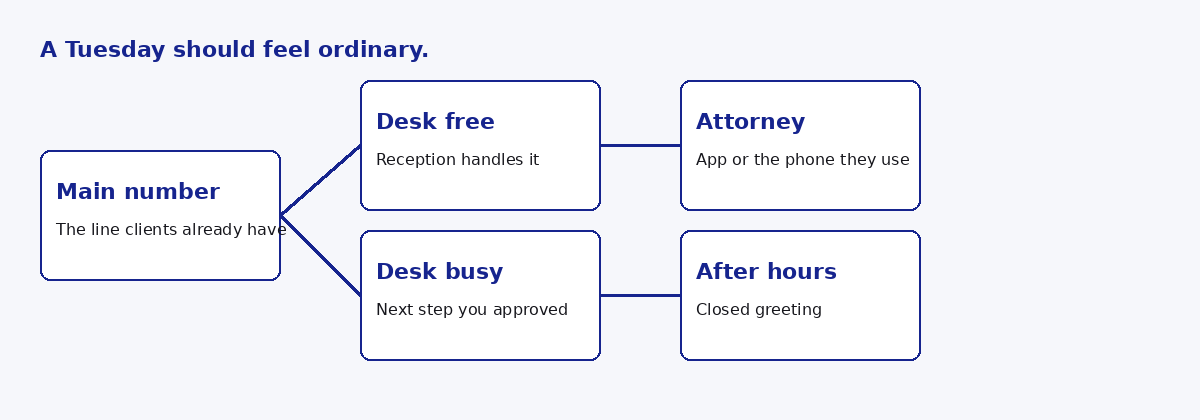
Attorneys stay on the same system without turning a personal cell into the office’s main number. After hours, callers hear a closed greeting and the call goes where you decided it should go. Night sounds like night. The office does not accidentally sound open because nobody remembered to change a setting.
None of that requires the office manager to become a technician. It requires a conversation about how the office should sound, and then a system that keeps sounding that way.
We don’t hand you a login
We don’t hand you a login and wish you luck. You walk us through how the front desk works today, including the awkward parts. We build the system on our side and test it before anyone’s number moves. You hear how calls will ring and you approve it. Then we move the numbers, switch the new system on, and train the people who answer.
After you start using it, a change is something you ask us to handle. Someone leaves. You add a location. The holiday greeting needs to go up on Thursday. You ask. Ordinary changes stay included. Ongoing support is free. Setup is a one-time quoted charge so we can build it right. Month to month.
If your office uses Clio, we can connect the phones to it and show you that on the same meeting. If you don’t, we still run the phones. We will not pretend a paid connector is the same as an integration we own.
A firm that already made the switch
Cartner & Fisichella is a law firm that already runs on RingFree. Pam Powers, the administrator there, put the useful part simply:
“Since switching to Ringfree, our office telephone service has been streamlined tremendously. Managing calls and voicemail is easier, and connecting office phones to our cell phones lets us stay accessible to clients when we are away from the desk. We have been very pleased with Ringfree and would gladly recommend them to any business looking for a reliable, user-friendly telephone service.”
Pam Powers, Administrator, Cartner & Fisichella Law Firm PLLC
How the thirty minutes actually go
You walk us through the desk
Who answers. What happens when they can’t. What after hours is supposed to sound like. Bring the awkward parts. That is the useful material.
We show you the system we would run
Not a tour of buttons. A recommended setup, how the switch works, and what it costs. Setup is quoted for that system. Support after you start using it stays free.
You decide if we are the fit
If we are not, we will say so. If you need an answering service or unlimited AI minutes, we are the wrong vendor, and we will tell you that on the call.
Straight answers
Is this an answering service?
No. Your people still pick up. Clients still reach the office, not a call center reading a script. What changes is who takes care of the phone system underneath your people.
Do we have to use AI?
No. AI Receptionist is optional. It is $149 per agent per month, with 500 minutes included. You hear it before a caller does. You do not need it to use the phones.
Will we keep our numbers?
Yes. Number porting is part of setup. Clients keep dialing the numbers they already know.
Is there a contract?
No. Month to month. You stay because it works, not because you prepaid a year.
What does free support mean?
After go-live, support and ordinary configuration changes stay free. Getting set up has a one-time fee, quoted for your system. See pricing.
See how the office would sound
Thirty minutes. We walk how you answer the phone, show you what RingFree would run, and leave you with a recommended setup and a number.
If the question is who owns the work after you buy: Support is the product.
The product page for firms is phone systems for law firms.